COURTESY PHOTO
News
Boys Town pilgrimage marked by spiritual bond, ‘choreography of the Holy Spirit’
April 9, 2026
(Account provided by Patrick Tyler, Ph.D., senior director, Child and Family Translational Research Center, Boys Town National Research Hospital.)
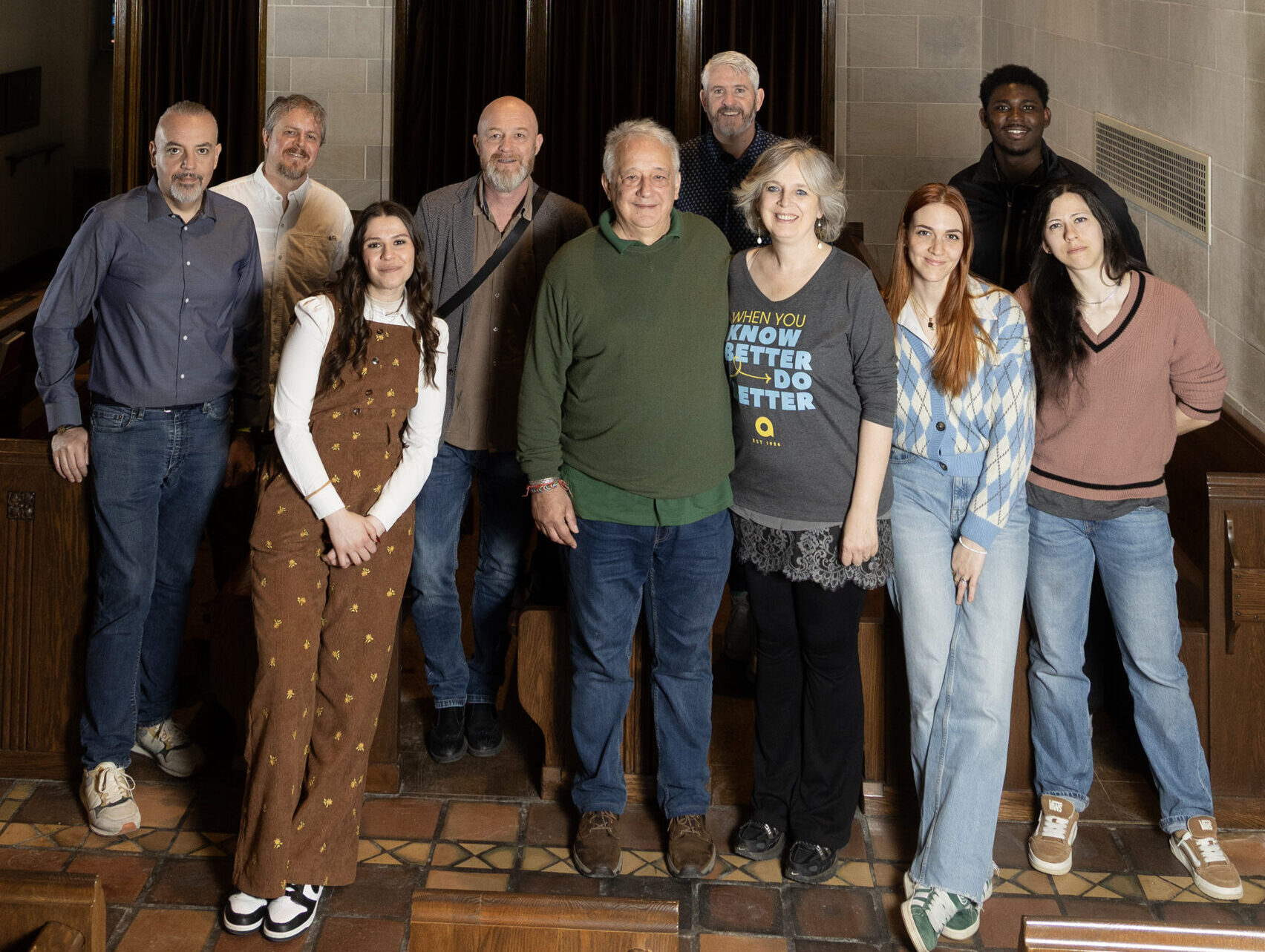
On March 21, 2026, Boys Town welcomed a delegation from the Coordinamento Nazionale Comunità per Minori (CNCM), a national organization that oversees approximately 150 communities serving vulnerable children and families in Italy. The delegation had just concluded their participation in the 70th Annual Conference of the Association of Children’s Residential and Community Services (ACRC) in Chicago before driving to Omaha for a daylong visit marked by hospitality, shared values and moments of quiet grace.
The group included CNCM President Giovanni Fulvi, Vice President Paolo Carli, Secretary Emmanuel Olivier and Board Member Vittoria Vitaloni, joined by cultural mediators and Italian “care leavers” — young adults who formerly lived in residential care. Their connection with Boys Town began a year earlier at the 2025 ACRC Conference in Boston, where Mr. Fulvi and Ms. Vitaloni met Dr. Patrick Tyler, senior director of translational research, and Jon Jelley, vice president of youth care operations.
That initial encounter revealed an unexpected and deeply meaningful link: the spiritual bond between Boys Town founder Servant of God (now Venerable) Father Edward J. Flanagan and Saint Giovanni Bosco, the great Italian champion of at‑risk youth.
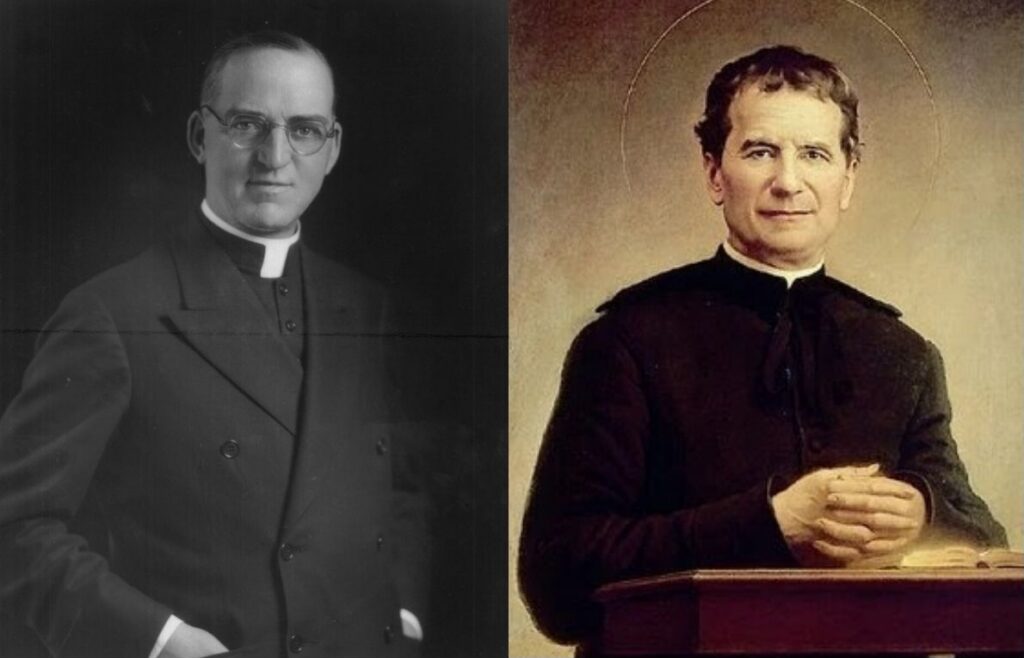
Venerable Father Edward J. Flanagan, left, and St. John Bosco, two priests who championed at-risk youths.
Both men of charity in their own eras, Don Bosco (1815–1888) and Father Flanagan (1886–1948) shared the conviction that “there are no bad boys,” shaping generations of educators and care programs around the world. For Ms. Vitaloni, the connection is especially personal — her own program in Turin sits beside the Basilica of Our Lady Help of Christians, where St. Bosco is entombed.
The delegation began their visit at Dowd Chapel, where Father Jeff Mollner, national director of mission and spirituality, welcomed them. In a moment of touching reciprocity, Ms. Vitaloni presented medals of St. John Bosco blessed at his tomb. In return, Boys Town’s Scott Hartman offered a unique rosary he had commissioned featuring St. Bosco on one side and Father Flanagan on the other — without knowing, until that moment, for whom it had been intended. Father Mollner blessed the rosary, which was then presented to Ms. Vitaloni.
Inside the chapel, the group paused before the stained‑glass window honoring St. Bosco and then gathered at Father Flanagan’s tomb to pray the rosary in Italian, lifting up prayers for CNCM, for Boys Town, and for children and families around the world.
‘HE AIN’T HEAVY’
The delegation continued to the Hall of History, where volunteer guide Henry Monsky — grandson of Jewish businessman Henry Monsky, who once loaned Father Flanagan $90 to start a home for boys — shared the early story of the village that Father Flanagan founded for boys of all races, religions, and cultural backgrounds. The visitors were especially moved by the story behind the iconic Two Brothers statue and its famous line, “He ain’t heavy, Father, he’s my brother.”
In the Boys Town archives, the Italian guests were delighted to discover correspondence between programs in Italy and Boys Town written shortly after World War II, along with letters from Father Flanagan, including one advocating for a young graduate who needed work. The letter was randomly selected from a stack by Ms. Vitaloni, and as she translated it into Italian, the group realized it was about one of the boys who inspired the Two Brothers statue. The experience felt “providential.”
Later, the delegation visited the family home of Colby and Rochelle Jacobs, who care for eight Boys Town girls alongside their three children. Though sleepy after a late prom night, the girls hosted the visitors warmly, offering a tour that was translated into Italian in real time. The Italian care leavers instinctively evaluated the environment — not critically, but out of a protective instinct born from their own experiences — and offered heartfelt praise for the love, structure and dignity they observed in the home. The Boys Town girls in the Jacobs home gleefully began making plans to visit Italy.
One lighthearted moment came when the Jacobs’ five‑year‑old son, confused by an affectionate forehead kiss from Ms. Vitaloni, learned it was simply the Italian way of greeting — and promptly went around the room seeking more.
After a full day touring campus, sampling Omaha’s neighborhoods, and sharing dinner at a local steakhouse, the delegation found themselves chatting spontaneously with local patrons about their visit to Father Flanagan’s tomb while watching the dramatic conclusion of a Nebraska NCAA men’s basketball tournament game. Their new acquaintance described the tomb as “a place of comfort and peace,” sharing memories of feeling warm air rising from the chapel vents beneath the benches as she read the inspiring words on the tomb.
It was only afterward that the group, so enthralled by the conversation about Father Flanagan, realized they had missed Nebraska’s exciting victory. They celebrated belatedly with a hearty “Go Big Red!” and made a quick stop for Husker apparel.
SHARED NEWS
The Italian delegation left Omaha the next morning under a radiant sunrise. The next day, while they waited at the Chicago airport, news broke simultaneously to both Boys Town and the delegation: Pope Leo XIV had declared Father Edward J. Flanagan “Venerable,” recognizing his heroic virtue and advancing his cause for sainthood. The next steps — beatification and canonization — each require a verified miracle.
What might have seemed like a sequence of coincidences felt, to those present, like the gentle choreography of the Holy Spirit. Their experience became a reminder of how grace works quietly through relationships, history and hospitality.
Father Flanagan, inspired by St. John Bosco, went on to inspire countless others through love, courage and unwavering trust in God’s providence. As he once said, “The work will continue, you see, whether I am there or not, because it is God’s work, not mine.”
This visit — rooted in shared mission and deepened by friendship across cultures — affirmed that God continues to raise up people who carry that work forward.
READ MORE FROM THE CATHOLIC VOICE: