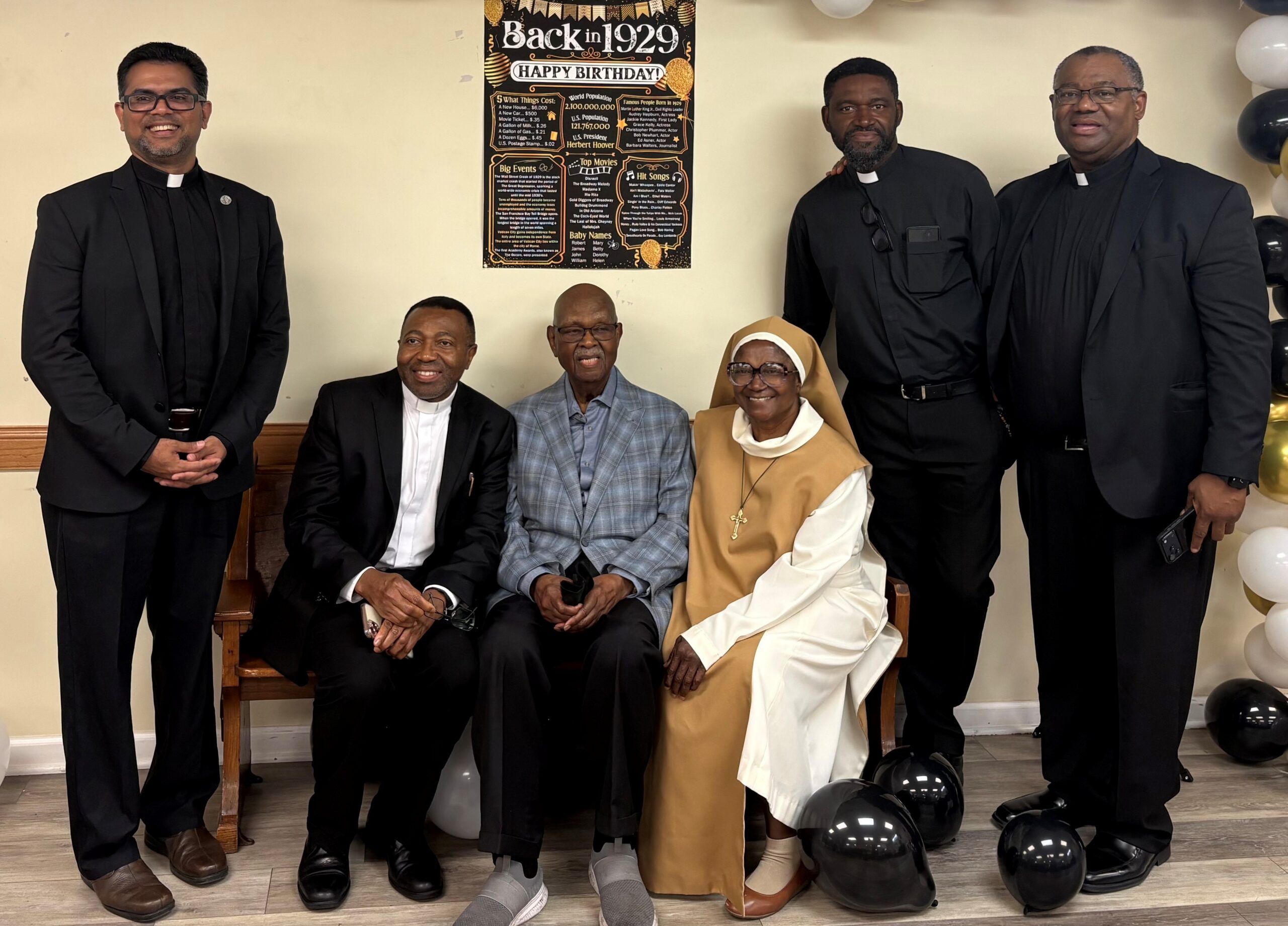
Deacon Ernie Spicer, seated at center, is surrounded by other clergy members and religious at his 97th birthday celebration in June. The party was held at his parish, St. Benedict the Moor in Omaha, in the hall that bears his name. COURTESY PHOTO
News
At 97, Deacon Spicer still makes an impact
November 24, 2026
Deacon Ernie Spicer doesn’t usually proclaim the Gospel at St. Benedict the Moor Church in Omaha.
But when he does, people pay attention.
“When he proclaims the Gospel, he proclaims it with affect,” his pastor, Father David Korth, said. “You can tell that he’s not just reading words on a page. He is sharing a message that he believes in deeply.”
At age 97, Deacon Spicer has slowed down on active ministry. But he still makes an impact – at his parish and in the wider community.
The deacon of 44 years mentors the people of his historically black parish, especially the young men. And occasionally parishioners prevail on him to read the Gospel passage at Mass.
Deacon Spicer’s listing in the bulletin says he’s retired, but when he’s needed, he’ll help, said Angela Hardin, an active member of St. Benedict the Moor who has served with Deacon Spicer for the National Black Catholic Congress (NBCC). Hardin is also coordinator of the archdiocese’s Black Catholic Implementation Team.
Deacon Spicer’s example is being held up during National Black Catholic History Month, a time to “honor the rich history, faith, and contributions of Black Catholics and reflect on their enduring witness of holiness, perseverance, and discipleship,” according to the NBCC.
For St. Benedict the Moor Parish and beyond, Deacon Spicer provides that witness.
Deacon Tim McNeil, chancellor of the archdiocese and director of the Diaconate Office, would agree.
“The mark of a good deacon is that he understands the Monday-through-Saturday lived experiences of his parishioners,” Deacon McNeil said. “St. Benedict the Moor parishioners have been the beneficiaries of Deacon Ernie’s compassion for decades. They turn to him often because he knows what it is like to walk in their shoes.”
STILL MINISTERING
Deacon Spicer doesn’t get around like he used to, but for years he ministered to the homebound and those in nursing homes, bringing them Holy Communion, praying and singing with them, and just visiting.
“I enjoyed that,” he said.
At nursing home prayer services, he would proclaim the Gospel and other readings for the day and offer a homily.
“I felt my ministry was more out in the community rather than in the parish,” he said. Serving at Mass on Sundays was necessary, he said, because of the parish’s small size, currently at about 200 members.
Physical limitations now keep him from some duties at Mass, but people like Hardin, fellow deacons and the people of St. Benedict the Moor aren’t ready for him to step down entirely.
“People keep telling me, ‘We want to see you at the altar. You don’t look right sitting in the pews,’” Deacon Spicer said in a recent interview at his Bellevue home. “That takes a certain amount of stamina that I just don’t have anymore.”
Having black clergy at the parish is important, he said, and he’s tried over the years to help promote vocations among his congregation.
“Our people want to see black clergy,” he said.
SEGREGATION
Deacon Spicer grew up in Wilmington, North Carolina, where his Methodist parents sent him and his three brothers to a segregated Catholic elementary school.
At the school parish, the young Ernie Spicer was baptized and received the sacraments of First Holy Communion and Confirmation. He was later married at the parish.
The segregation was common at the time, he said, even in the Catholic Church. “We could go to St. Mary’s, which was the white church, but you didn’t feel comfortable there.”
After graduating from a public high school, he joined the Air Force and stayed for 28 years, retiring in 1978 as a senior master sergeant. His military career as an administrative superintendent – a “pencil pusher,” as Deacon Spicer would say – took him and his wife, the late Henrietta Spicer, around the world.
Together they adopted two children, a boy and a girl, and lived in places like Thailand, Germany, England and in the United States in Florida, South Dakota, New Mexico and Nebraska.
While in Nebraska, he took night classes and earned a history degree, graduating in 1969 from the newly named University of Nebraska at Omaha.
He and his wife decided to retire in Nebraska, and in 1979 they joined St. Benedict the Moor.
Deacon Spicer was ordained in 1982, and he relished his new ministry.
“I consider it one of the most satisfying things that happened to me,” he said, because he learned more about the Church, grew in faith and could assist at Mass and preside at funeral services, Baptisms and weddings.
Henrietta passed away in 1997. Their children – Sandy Spicer Williams and Ernie Jr. – both live in Houston and are chief among Deacon Spicer’s passions, Hardin said.
He also maintains a keen interest in the NBCC and its work. He led the archdiocese’s participation in the organization until Hardin took over the role.
‘LONG WAY TO GO’
Racism, Deacon Spicer said, remains a harsh reality in the United States and in the Church.
“We look back on our past, where we came from, where we are today as black people, and we’ve got a long ways to go still – a long, long way to go.”
At his parish, Deacon Spicer mentors young men, taking an interest in their lives, helping form them into outstanding young people, Hardin said. “That’s just natural for him.”
Deacon Spicer has long been a role model, she said, who makes himself available to everyone. He’s not only respected but loved, Hardin and Father Korth said.
More than 100 people showed up for his June birthday party, held at the parish hall named after him.
“He’s been like a father to me,” said Hardin, who’s known Deacon Spicer since she was 8.
“I love him to pieces,” she said. “I really do.”
READ MORE FROM THE CATHOLIC VOICE: