JOE DEJKA
Encountering Jesus
Don’t miss this Jubilee jewel near Schuyler
September 4, 2025
High on a hill near Schuyler is a hidden gem.
It’s called the St. Benedict Center, a name that can’t begin to reveal what’s in store for the curious visitor.
The center is part museum, part church, part lodge and all inspiring.
As a retreat center, this complex caters to visitors who are looking to grow their faith.
That makes it a natural destination for Catholics on pilgrimage during the 2025 Jubilee Year.
Other designated pilgrimage sites in the Archdiocese of Omaha include St. Augustine Indian Mission Church in Winnebago, Immaculate Conception Church in St. Helena, St. Cecilia Cathedral in Omaha, St. Anthony Church in Cedar Rapids, Holy Family Shrine in Gretna, Assumption of the Virgin Mary Church in Lynch and Immaculata Monastery in Norfolk.
Visitors to the St. Benedict Center should plan to spend hours exploring its many offerings, from quilted Stations of the Cross and a “Corn husk Madonna” statue to its display of a rare reproduction of the St. John’s Bible, the first hand-written Bible commissioned by a Benedictine monastery in more than 500 years.

Situated on a hilltop over the city of Schuyler, Nebraska, the St. Benedict Center at 1123 Road I is easy to find for Catholic pilgrims seeking it out. JOE DEJKA

Pilgrims are welcome and invited to sign in at the St. Benedict Center. JOE DEJKA
Benedictine Father Thomas Leitner, the center’s administrator, said getting chosen as a Nebraska pilgrimage site was a great honor.
For those who want to deepen their relationship with God, the retreat center is already a place of pilgrimage, he said. People attend retreats and programs, seek spiritual guidance or just spend time in prayer by themselves, Father Leitner said.
Like other sites, the center is accessible and beautiful, he said. It is located four miles north of Schuyler on Nebraska Highway 15.

A statue of St. Benedict – patron saint of Europe – stands over the lake at the St. Benedict Center. JOE DEJKA
“St. Benedict Center is really a retreat, and it’s a place where a lot of opportunities are given for people for connecting with God,” he said.
During a visit, pilgrims can pray in the main chapel or the intimate Adoration chapel.
“One central element should be just to be still in God’s presence and especially to adore the Blessed Sacrament as exposed or just praying in front of the Tabernacle,” he said.

The monstrance holds the Blessed Sacrament in the Adoration chapel at the St. Benedict Center. Visitors are invited to spend time there. JOE DEJKA
Apart from the areas of worship, the center has the feel of a museum, with displays, a gift shop and works of art. The retreat center is a large complex, with parts reserved for retreatants, some staying overnight. Pilgrims should be mindful that there could be a silent retreat taking place and respect the privacy and solitude of those guests.
Upon entering the center, one comes face-to-face with a large mural on the wall ahead. The mural is called “The Walk to Emmaus Mural,” and it depicts the disciples’ walk to Emmaus, during which Jesus opens the Scriptures to them and reveals Himself in the breaking of the Bread.

Upon entering the St. Benedict Center, visitors are greeted by “The Walk to Emmaus Mural,” pictured here in a panorama photograph showing the arches of adjoining halls. The disciples walk the road to Emmaus, and Jesus opens the Scriptures to them, revealing himself in the breaking of bread. JOE DEJKA
In the hallway to the main chapel, you pass an Our Lady of Guadalupe print and the quilted Stations of the Cross – with each station an individual quilt. By the chapel doors you come upon the “Fountain of Life” holy water fountain that trickles down a tall stone pillar.

The image of Our Lady of Guadalupe hangs in the hall outside the chapel at St. Benedict Center. This image of Mary is particularly revered in Mexico. In 1531, Mary appeared to Juan Diego, an Aztec who converted to Christianity and became a saint. The carving at right is a Makonde Easter candle stand carved by an African artist. JOE DEJKA

Benedictine Father Thomas Leitner, administrator of the St. Benedict Center, said it’s a great honor to be selected as a Jubilee Year pilgrimage site. Hung behind him are quilted Stations of the Cross. JOE DEJKA
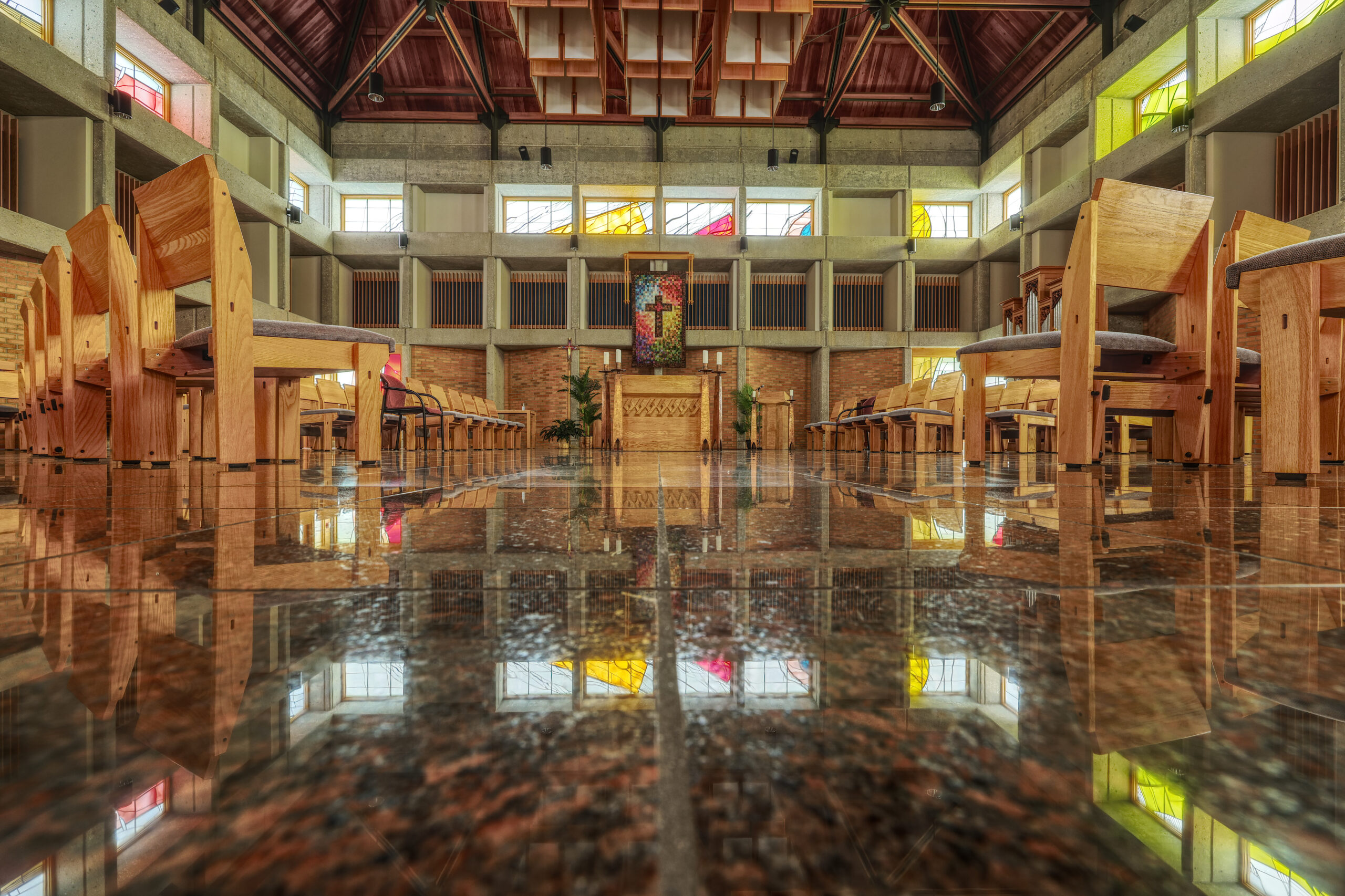
Upon entering the chapel, one observes the stained glass windows, which circle the room and let in an abundance of light. Instead of containing Biblical images, they are more abstract, featuring colors: yellow of corn and soybeans, blue of Nebraska waters, white snow.
The late Benedictine Father Polykarp Uehlein created the stained glass windows with the idea of bringing the colors of nature from Nebraska into the place of worship.

Visitors to St. Benedict Center are welcome to pray in the main chapel, pictured here with its bright stained-glass windows. JOE DEJKA
Leslie Kreikemeier, 51, recently visited the center on retreat with fellow teachers from Guardian Angels Central Catholic in West Point.
“The stained glass is very unusual,” Kreikemeier said. “It very much reminds you of the elements of nature and God’s creations.”
She likes how the center’s designers mixed nature in with the architecture.
“Even when you’re inside, you feel like the nature is just right there,” she said. “There’s so many different textures, with the concrete and the bricks and the wood, and then you look outside, you see the water and the flowers.”
One room is devoted entirely to the St. John’s Bible. Through clear display cases, visitors can inspect the full-size Bible volumes and read about the monumental task undertaken by calligraphers and artists to create the original.

One volume of the rare reproduction of the St. John’s Bible sits protected in a display case at the St. Benedict Center. The open pages show the elaborate and detailed “illuminations” on the pages, which is how the artists referred to the colorful artwork. JOE DEJKA
The original came about through a collaboration between calligrapher Donald Jackson and the monks of St. John’s Abbey in Collegeville, Minnesota. Producing the Bible took 17 years.
Only 299 copies of the St. John’s Bible, referred to as the Heritage Edition, were made.
The 1,150-page Bible contains artwork that its makers call “illuminations” as opposed to illustrations.
The illuminations – 160 major ones – are more “open-ended” than illustrations and meant to inspire.
On display are quills of turkeys, geese and swans that the artists used on the pages.
In an interactive kiosk, visitors can browse through every page.
“It’s almost indistinguishable from the original,” Father Leitner said.
Adjacent is a display highlighting the work of the Missionary Benedictines around the world.
In a nearby hallway, visitors will find glass cases with nearly 200 statuettes of Mary from all over the world. The late Jane Best of Omaha donated the collection. Best built her collection by asking friends to bring home Madonna statuettes when they traveled.
As such, the statues reflect different cultural interpretations of Mary.

A collection of more than 200 statuettes of Mary are on display at the St. Benedict Center. The collection is a gift of the late Jane Best of Omaha. JOE DEJKA

A statuette at the St. Benedict Center is described in Spanish as “Our Lady of the Little Town Queretaro.” JOE DEJKA
Outside in a courtyard, another version of Mary features a Nebraska twist. John Laiba’s so-called “Corn Husk Madonna” statue features the Virgin Mary emerging from a corn husk. It is, of course, a connection to Nebraska but also indicates that Mary is the special fruit of God’s creation. The husks symbolize the old falling away.

Mary, mother of God, is depicted as wrapped in corn husks in this statue in the St. Benedict Center courtyard. Artist John Laiba of Omaha created the statue. JOE DEJKA
Surrounded by agricultural fields, the center is quiet and serene, said Cathy Pasko, 68, of Elkhorn.
Pasko and fellow quilters from the Cottonwood Quilt Guild regularly visit the center for quilting retreats.
Even though they come to quilt, the center is “very moving,” she said.
“We come up here to quilt three or four times a year, and it’s a hidden gem,” Pasko said. “So don’t tell too many people about it.”
Pilgrims who visit during the holidays will discover an added bonus.
For two weeks each year in early December, the center hosts a craft and gift sale. The products are made by about 50 area artists. The center will be beautifully decorated for the season, and numerous nativity scenes from around the world will be on display. The sale is scheduled for Nov. 30-Dec. 14.
READ MORE FROM THE CATHOLIC VOICE: