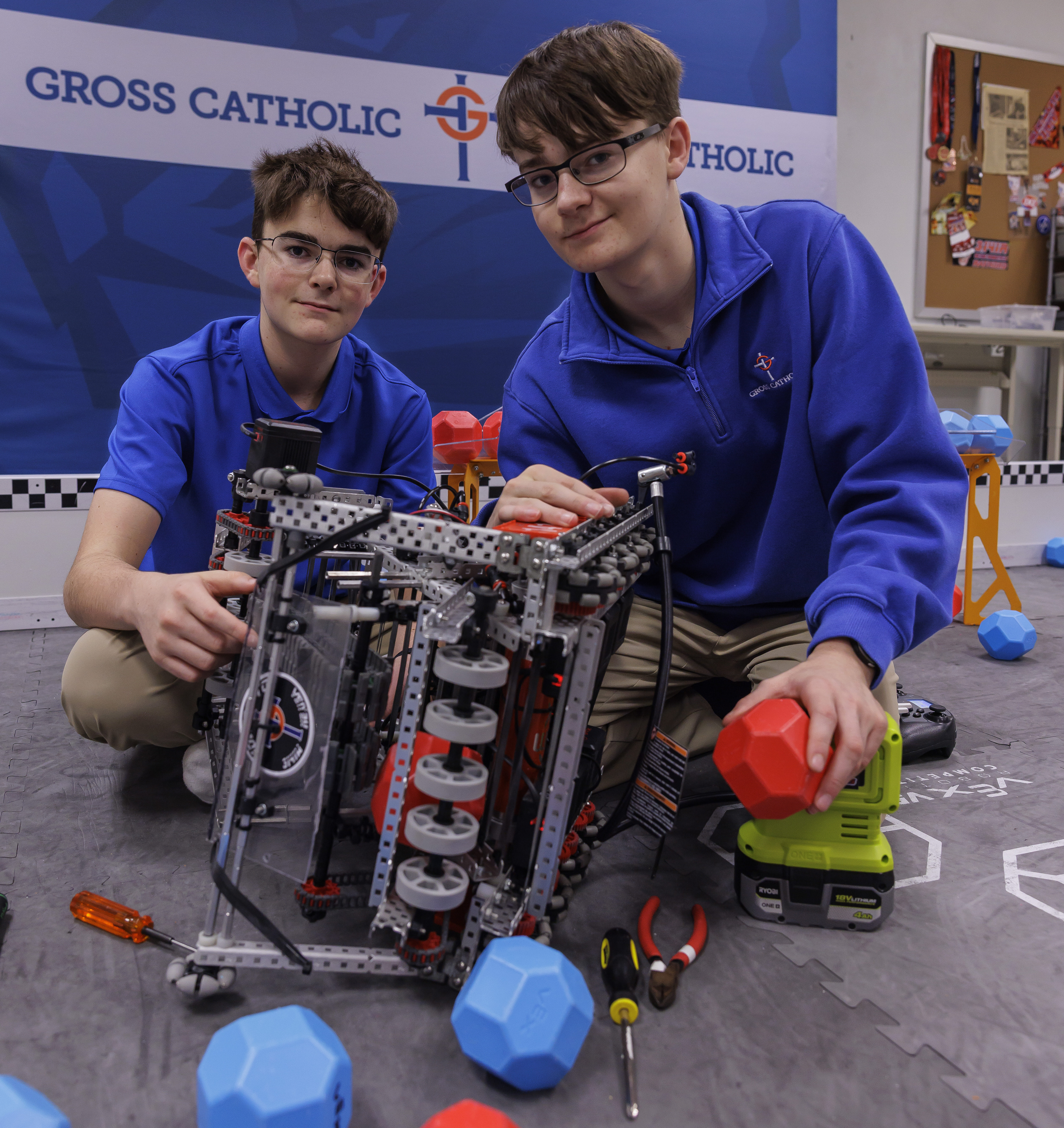
Gross Catholic freshmen, from left, Gavin Love and Aiden Love. ROBERT ERVIN
News
Building more than robots: How Gross Catholic students engineer success
January 21, 2026
A version of this story originally appeared in the January 2026 edition of The True Voice magazine. Copies of the magazine can be found at parishes across the archdiocese.
The robots begin as boxes of gears, wires, wheels and bolts when they arrive at Daniel J. Gross Catholic High School in Bellevue.
But the finished products — and the students who build and compete with them — have traveled far beyond the walls of the school. Gross Catholic’s robotics program has taken students from Nebraska to regional meets across the Midwest and world championships as far away as China.
And those students – their robots, too – have won awards at nearly every stop, with trophies for three state championships among the multitude of awards spread across two classrooms occupied by longtime Gross Catholic STEM (science, technology, engineering and math) teacher Steve Hamersky.
While the robotics program has brought students new experiences in new places, the skills learned from building and competing with robots carry them much further in life, Hamersky said.
“We’ve had people go into medical fields, engineering fields, computer science fields — and one of the things you do find is that they have been doing this teamwork stuff throughout high school,” he said. “When they get to college, anything that involves teamwork, they are ready for it.”

Gross Catholic STEM teacher Steve Hamersky is pictured with sophomores Patrick Giddens, left, and Anthony Ferony. ROBERT ERVIN
Hana Abbott, the school’s principal for three years, said the robotics program is a logical extension and embodiment of the Marianist educational pillar to teach for adaptation and change.
“One of the things we always emphasize is Mary’s ‘yes,’” she said. “Whether it’s academics or extracurriculars, we always ask you to say ‘yes’ to something, and I’m glad we can offer robotics. It’s something very much to be proud of, and to see kids so dedicated, choosing to give up their summers to compete at such a high level.”
From humble beginnings 16 years ago, when the first boxes of parts arrived for the school’s first VEX Robotics teams, Gross Catholic annually produces several two-person teams, with many of the students putting in thousands of hours buildingand competing since elementary school.
On a recent Wednesday in Hamersky’s classroom, freshmen twins Gavin and Aiden Love demonstrated how their robot works, flipping through a binder that catalogs the programming. They’ve been involved with robotics since fifth grade.
With 80 pages of schematics, the documentation seems exhaustive, until Gavin mentions that some of his peers have nearly 1,000 pages.

Twins Gavin Love, left, and Aiden Love test their robot. ROBERT ERVIN
“I’m the programmer, so I’ve learned quite a bit of code, and we’ve [designed] a couple of our robots,” Gavin said. “We have to document all that we’ve done. So I’ve been keeping a record of what we’ve done, and that’s been an education.”
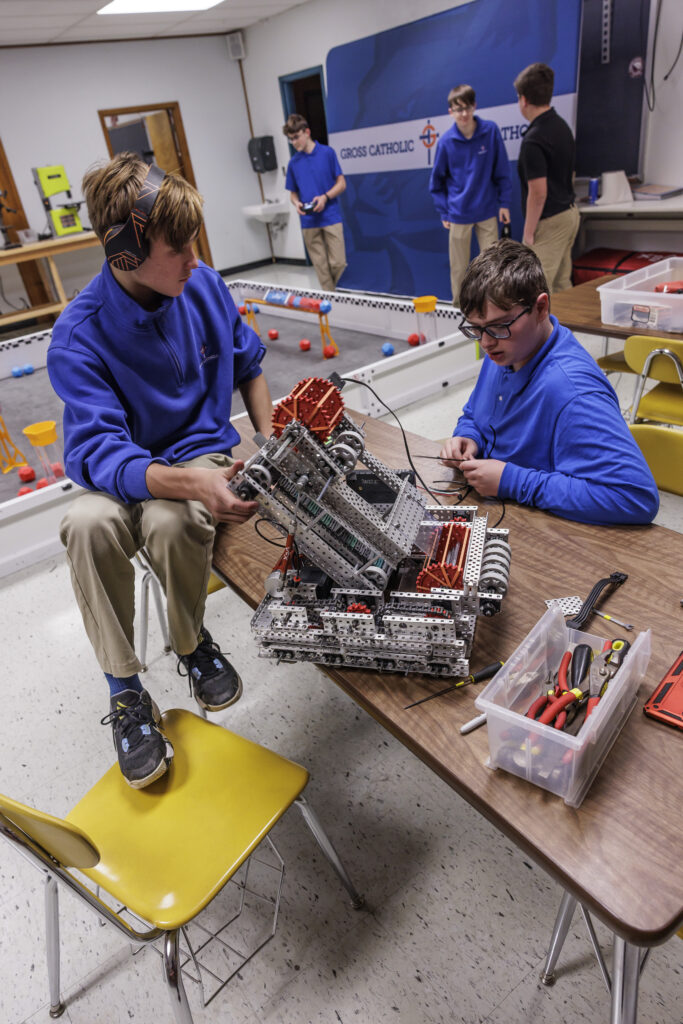
A few tables away, Patrick Kleinsasser, a sophomore, estimated that he’s put 300 hours into his robot this school year alone — which includes moving onto the second iteration of his robot after the initial version struggled with a particular aspect of the tasks it needed to complete.
“I definitely learned a lot through building and coding the robot especially,” he said. “It’s definitely very slow and takes a lot of time.”

Gross Catholic sophomore Alex Patrick Kleinsasser works on his robot. ROBERT ERVIN
While the building process is tedious and takes weeks to complete and months to fine tune, the matches are lightning fast in comparison. Teams program a 15-second autonomous period, followed by one minute and 45 seconds of controlled competition.
The robots work inside a square arena with a series of tubes and goals, scoring points based on where and how many colored balls they deposit, in addition to completing other specific tasks. Each team involves two students working hand in hand with partners from a different team to score the most points and win their particular bout in the competition, all the way to the finals.
“Teamwork, communication, negotiation, compromise – you know, all those things that make a good team,” Hamersky said. “That’s something they certainly get out of this as they work together and develop their robots and develop their strategies.”
Meets are awash in camaraderie and collaboration.
A local competition often begins early Saturday morning, with students arriving well before preliminary rounds to ensure everything about their robot is at its best. Winners are crowned several hours later, with banners and trophies to bring back to school.

Team members display their work. ROBERT ERVIN
In the meantime, students work together with anyone and everyone, from teammates to competitors from other schools they may have just met.
Robotics competitions breed a type of teamwork that benefits participants both now and in the future, Hamersky said, with schools sometimes sharing a plan with partners or parts with another team. Gross Catholic’s spare parts have been used in robots that eliminated its own teams, he said.
Robotics has become a logical, if newer, extension of the Marianist principles Gross Catholic is dedicated to teaching every day.
“It’s about growth in family spirit,” Abbott said, “and they’re working together as a family.”
That sense of community embodied by the robotics program starts far away from competitions, said sophomore Jaxon Sindelar.
As he worked on his robot after school one day, students on another Gross Catholic team stopped what they were doing to help him fix a problem with the front of his robot. The whole scene took place just a few feet from a wall of trophies and banners celebrating the successes of past and present robotics teams from the school.
“Ultimately, we all come from Gross. We all come from the same place,” he said. Someone’s always there to help, and “that’s very cool.”

READ MORE FROM THE CATHOLIC VOICE: