
A statue of St. Kateri Tekakwitha, the first Native American saint, stands outside St. Augustine Indian Mission Church in Winnebago. JOE DEJKA
News
Pilgrims will find Native American culture, faith at St. Augustine
September 18, 2025
A road trip to the Winnebago reservation could bring travelers face-to-face with a unique Catholic church.
At St. Augustine Indian Mission Church, where the people of the Winnebago and Omaha tribes are served, Masses incorporate Native American culture in celebration and setting.
The church has the feel of a museum, adorned with banners, stained glass, art and images bridging native and Catholic traditions.
The Archdiocese of Omaha has designated St. Augustine as a pilgrimage site for the 2025 Jubilee Year. Pilgrims are invited to visit the church about 75 miles north of Omaha.
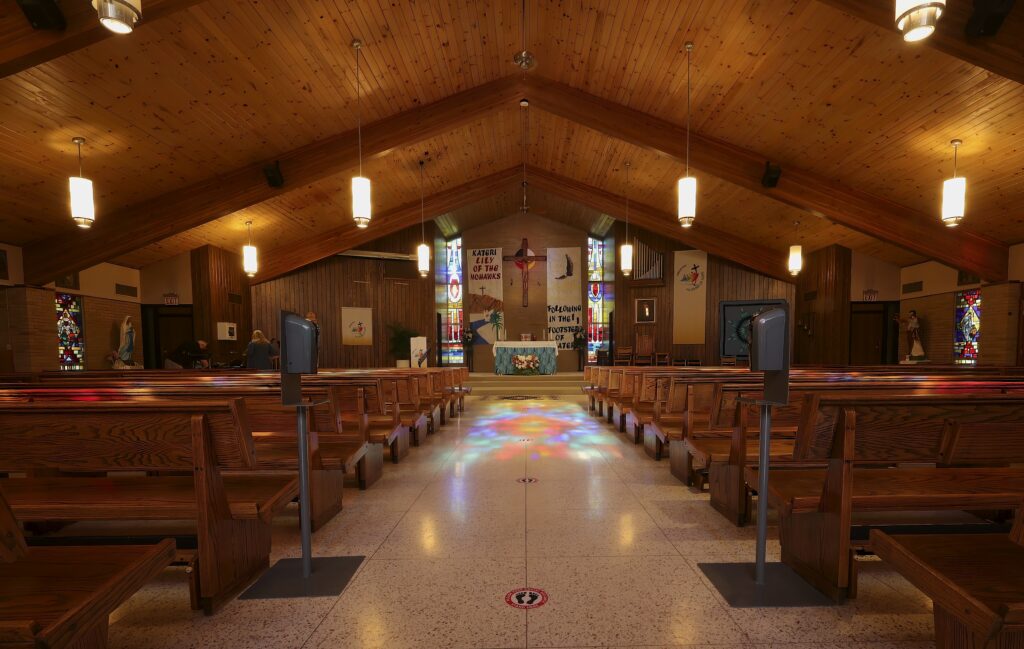
Warm and inviting St. Augustine is full of items reflecting Native American culture. JOE DEJKA
Other Jubilee pilgrimage sites: St. Cecilia Cathedral in Omaha, St. Anthony Church in Cedar Rapids, Holy Family Shrine in Gretna, Assumption of the Blessed Virgin Mary Church in Lynch, Immaculate Conception Church in St. Helena, St. Benedict Center in Schuyler and Immaculata Monastery and Spirituality Center in Norfolk.
Recently St. Augustine pews filled with students from the St. Augustine Indian Mission School attending their back-to-school Mass.
Before the Mass started, Deacon Don Blackbird produced a burning bowl of cedar, and, using an eagle feather, fanned smoke around the altar and over the worshippers in the pews.
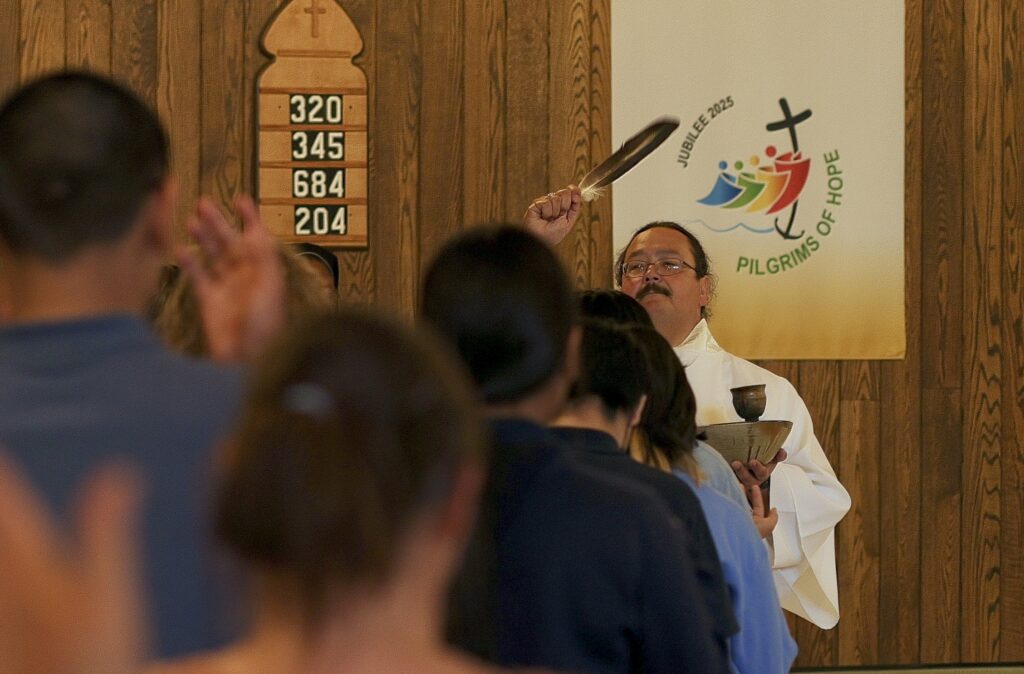
Deacon Don Blackbird, a member of the Omaha Nation and principal of St. Augustine Indian Mission School, uses an eagle feather to fan cedar smoke over worshippers during a recent Mass. JOE DEJKA
The purpose of burning cedar is the same as when a priest or deacon uses a thurible to burn incense for purification and sanctification, Deacon Blackbird said.
“Native people used incense in the same way, to carry up the prayers to God,” he said. “The theology behind the uses are the same. We use eagle feathers because the eagles flew highest in the sky and closest to the creator, so the eagle is seen as sacred.”
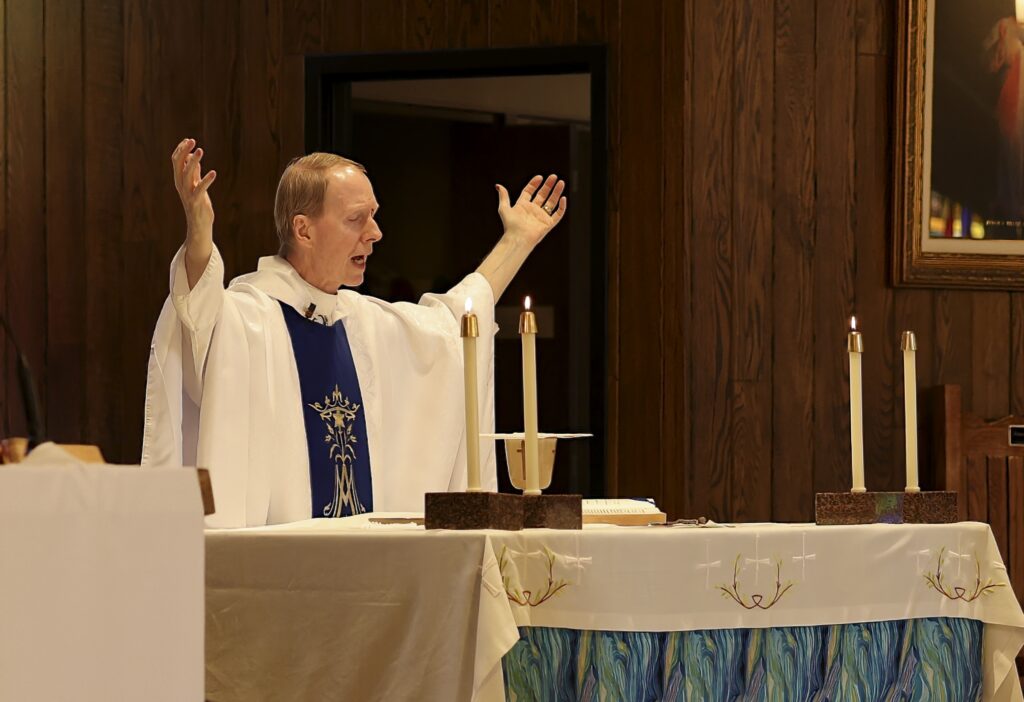
During Mass, Father Kevin Joyce, senior associate pastor, conducted the Liturgy of the Eucharist using earthen vessels to hold the host and the wine that were about to become the Body and Blood of Christ.
JOE DEJKA
The vessels are a nod to native culture and tradition, Deacon Blackbird said.
“We treat those vessels the same way as any other Catholic Church would treat their precious metal vessels,” he said.
According to Deacon Tim McNeil, chancellor of the Archdiocese of Omaha, inclusion of the native cultural elements is permitted at the church.
Deacon Blackbird said that in the late 1980s, local priests began integrating Native American cultural elements into the liturgy.
“But even before that, we’ve been embracing the culture of the local native people, and so finding ways to inculturate the Mass without doing anything that is in contrast” to it.
They are, he said, “trying to walk that line between where native belief and Catholic belief come together.”
The church is part of the St. Augustine Indian Mission established in 1909 by then-Mother Katharine Drexel and the Sisters of the Blessed Sacrament, who pledged to serve American Indians and African Americans. The saint and her sisters financed and oversaw planning and construction of the mission and school.
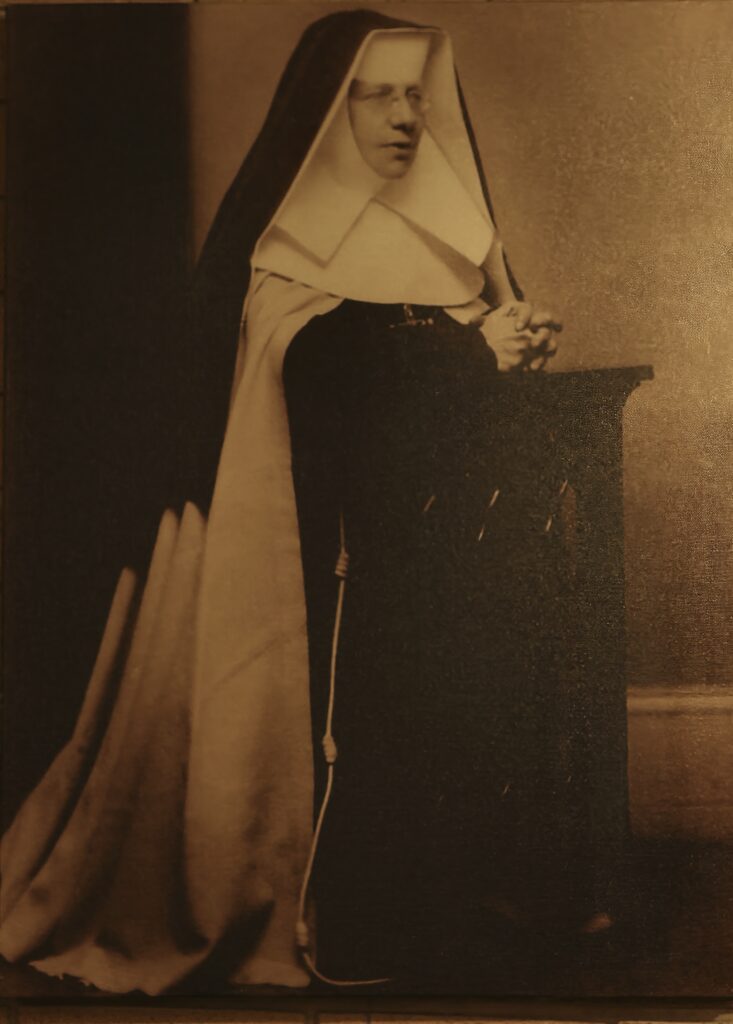
This image of St. Katharine Drexel is displayed inside St. Augustine. JOE DEJKA
During her lifetime, St. Katharine Drexel opened, staffed and directly supported nearly 60 schools and missions, many in the western and southwestern United States.
Pope John Paul II canonized her in 2000.
According to the Vatican, she possessed an “undaunted spirit of courageous initiative in addressing social inequities among minorities.”
“At the current time,” said Father Mark Bridgman, associate pastor, “it’s the only institution in Nebraska founded by a saint.”
Yet another saint figures prominently in the church.
Images of St. Kateri Tekakwitha are on display.
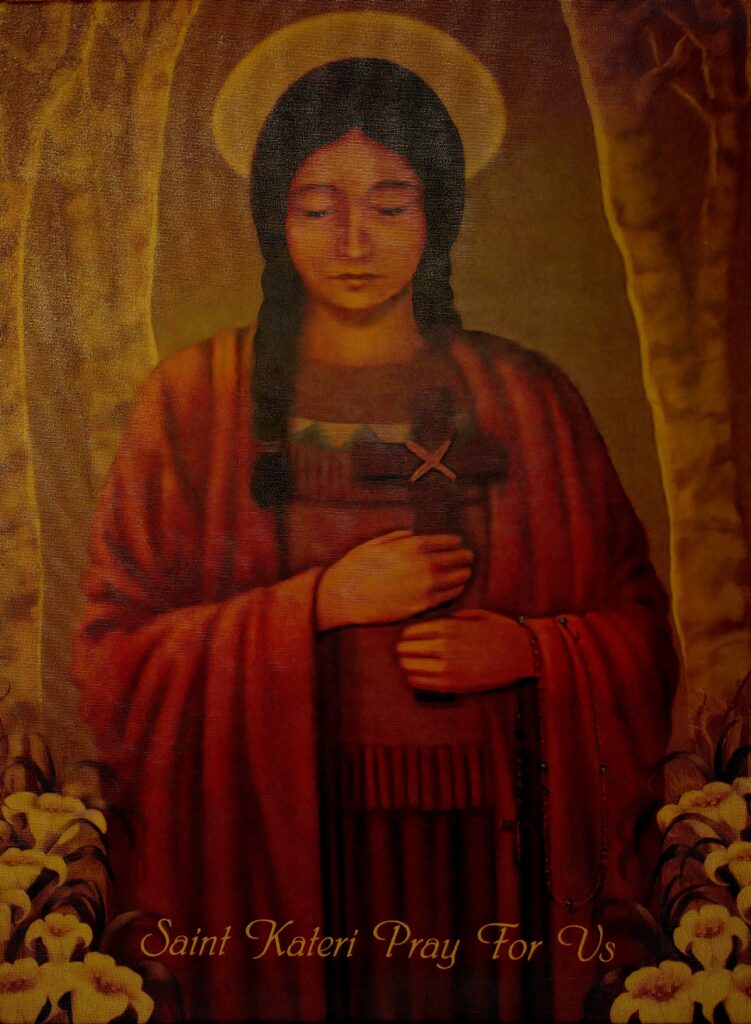
This portrait of St. Kateri Tekakwitha at St. Augustine was created by Nellie Edwards. JOE DEJKA
She was born to native parents in 1656 in what is now New York state. In 2012, Pope Benedict canonized her as the first Native American saint.
In St. Augustine is a portrait of St. Kateri – created by Nellie Edwards and titled “Holding on to Faith” – picturing the saint with lilies. Another portrait shows her gazing at a large wooden cross. It is a reproduction of an original 1949 painting by Winnebago artist Charles “Curtis” Beaver.
Behind the altar, banners hang that say “Kateri Lily of the Mohawks” and “Following in the footsteps of Kateri.”
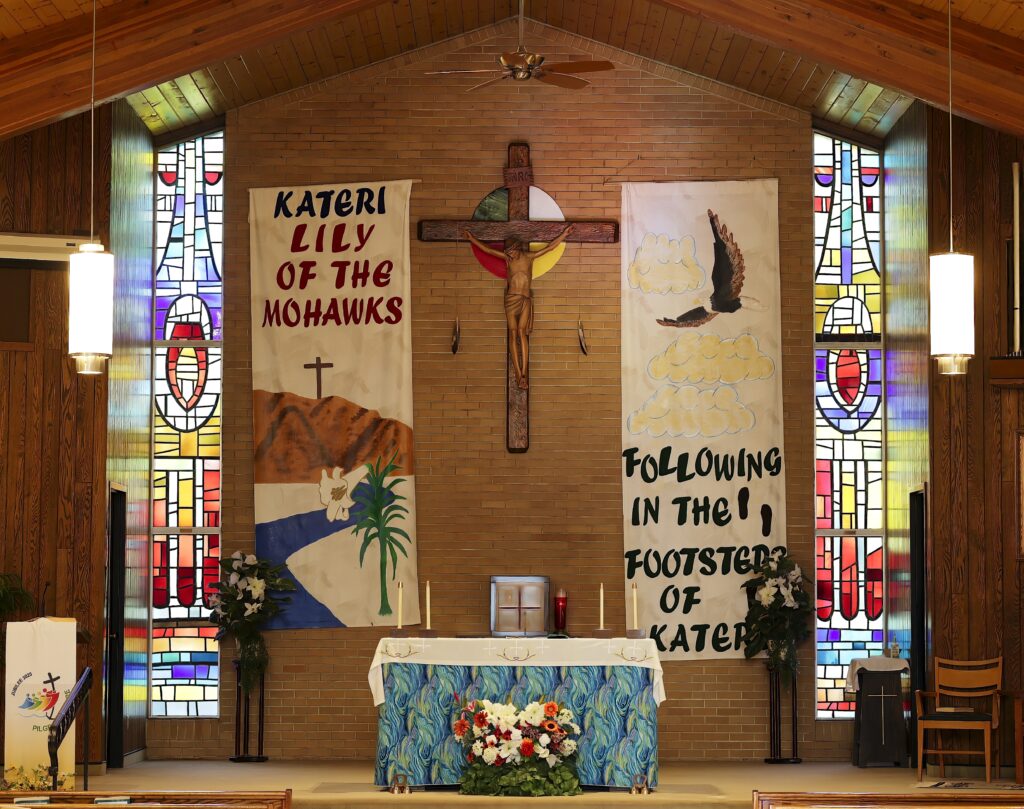
JOE DEJKA
Outside, a statue of St. Kateri stands on the front lawn of the church.
Deacon Blackbird said the parish’s biggest devotion is St. Katherine Drexel, who founded the school, built the mission and lived among the people for a time.
However, the native people developed a devotion to St. Kateri.
“That devotion kind of evolved through our people recognizing within her the same values that are found in both native culture and the Catholic Church,” he said.
Native people long prayed for the canonization of St. Kateri and now pray for her intercession, he said. Currently they are praying for the canonization of Nicholas Black Elk, the Oglala Lakota holy man.
The architectural features of the church, built in 1972, are intended “to reflect and honor the native people and to elevate them into equal partners in the Catholic faith,” Deacon Blackbird said.
Stained glass windows, for instance, depict Native American priests, bishops and ministers serving the people in sacraments and works of mercy, he said.
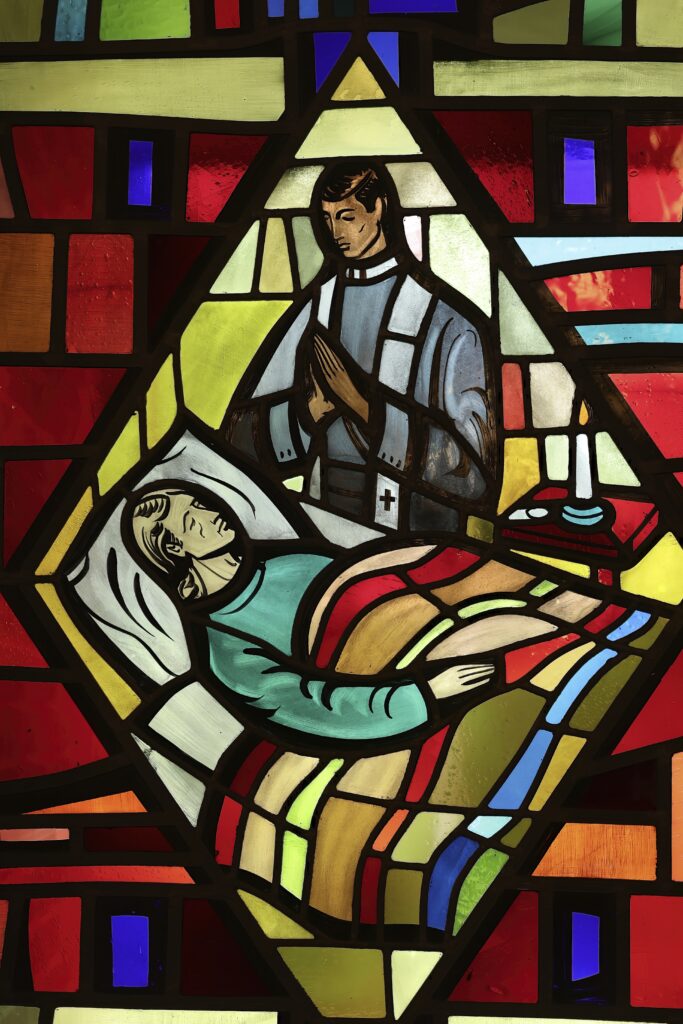
A Native American priest is depicted anointing a sick man in a stained-glass window. The window is one of 12 in the church that depict the seven sacraments and works of mercy. JOE DEJKA
Colorful mosaic tiles in geometric shapes are built into the exterior of the church, reflecting Plains Indians’ tradition, he said.

JOE DEJKA
The Winnebago traditions are reflected in ribbon-work on the vestments and altar cloths and other items in the church.
The main Crucifix on the wall behind the altar is set against a medicine wheel, an ancient sacred symbol. The circle is divided into quarters colored white, yellow, red and green.
On either side of the Crucified Jesus are eagle feathers.
Dubbed the “Feathers of Honor Cross,” the design was created by a fifth-grader, Dubz Bearridge. It has become the main symbol of the St. Augustine Indian Mission School, Father Bridgman said.
“Feathers are given to those who have done something heroic and some type of sacrifice, and so they’re very heroic, very sacrificial … so that fits it quite a bit,” he said.
On a front wall facing the pews hangs a star quilt. More than just a blanket, the star quilt is a significant symbol for the Lakota and Ogala people.
Father Bridgman said Native Americans pray while making star quilts, which are said to be based on the Morning Star and are given away to mark special events.
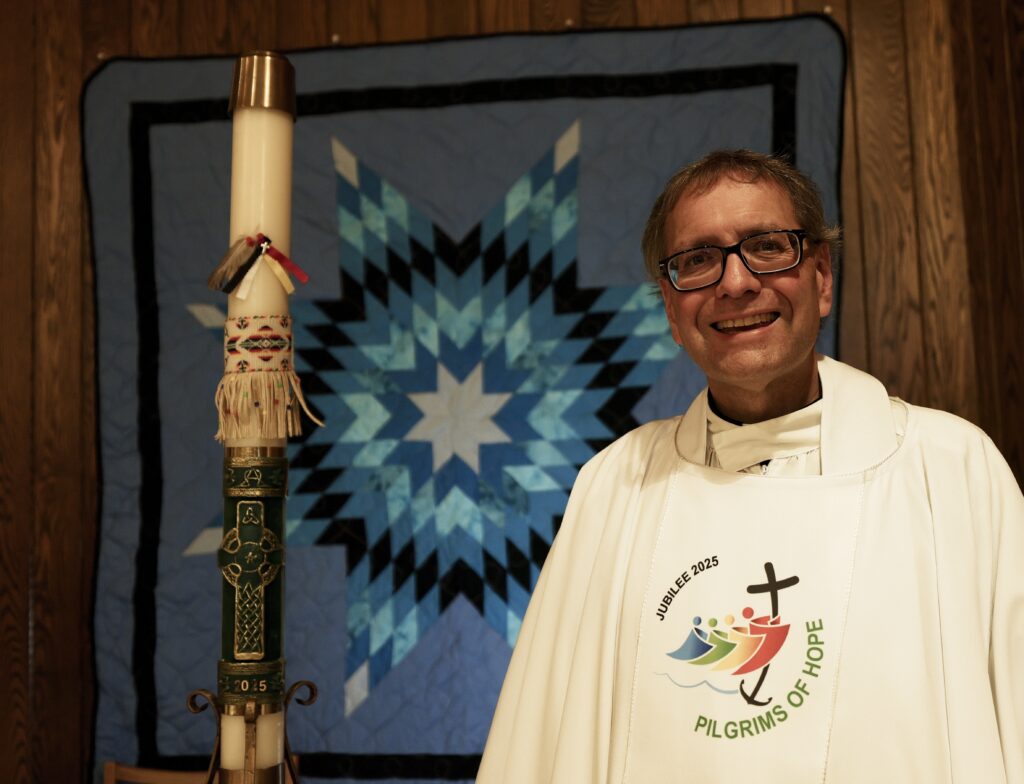
Father Mark Bridgman has cataloged the various Native American items and features in St. Augustine. A star quilt and decorated candle are among them. JOE DEJKA
“When a star quilt is given away, we fold them in half and wrap the person in them because we’re wrapping the person in our prayers and our love,” he said.
Other statues within the church include Our Lady of Lourdes, St. Joseph, St. Therese of Lisieux and St. Jude Thaddeus.
Roadtrippers to the church can enjoy the natural beauty of the Winnebago reservation, which is situated in the rolling hills along the Missouri River.
The town has seen progress economically through the efforts of Ho-Chunk Inc., the economic development arm of the Winnebago tribe of Nebraska.
Visitors who make the pilgrimage may want to pick up a latte or smoothie at the SweetWater Cafe, a coffee shop with a modern look and feel that would fit in the trendiest areas of Omaha.
The cafe sits in the Ho-Chunk Village, a modern mixed-use neighborhood of homes, apartments and businesses.
Yet, in light of such progress, tribal members work to keep traditions alive with their children.
On the same day that the schoolkids attended Mass, some also joined in a traditional Indian corn harvest.
Behind the church, locals built a wood fire and boiled hundreds of ears of corn in a large vat. The children helped remove the kernels by hand, which were then dried and stored.
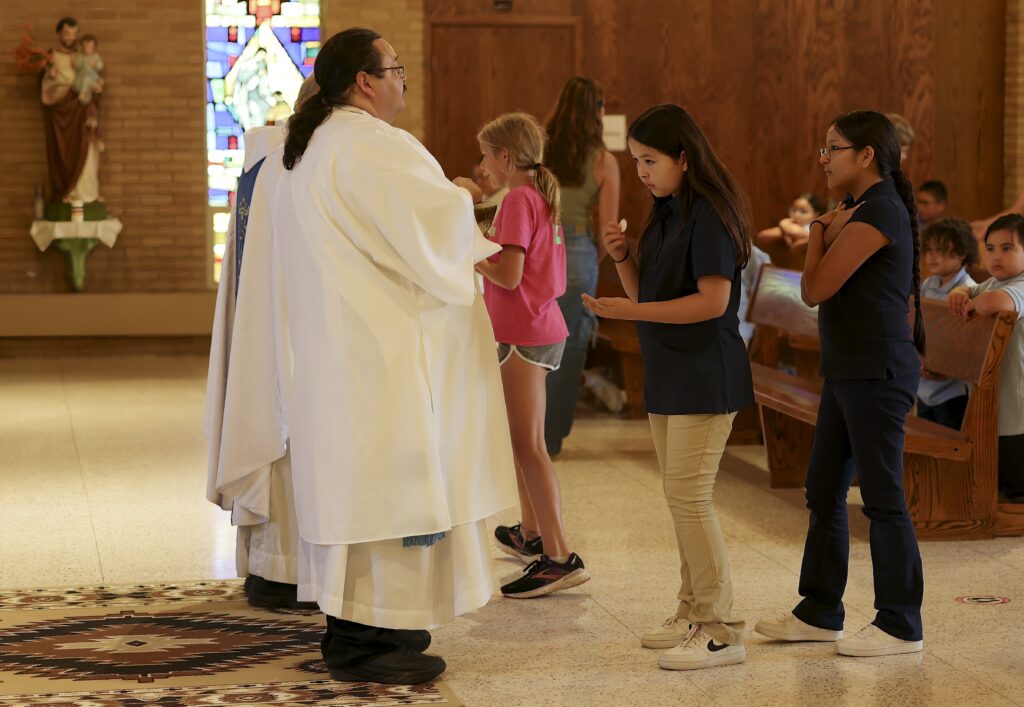
JOE DEJKA
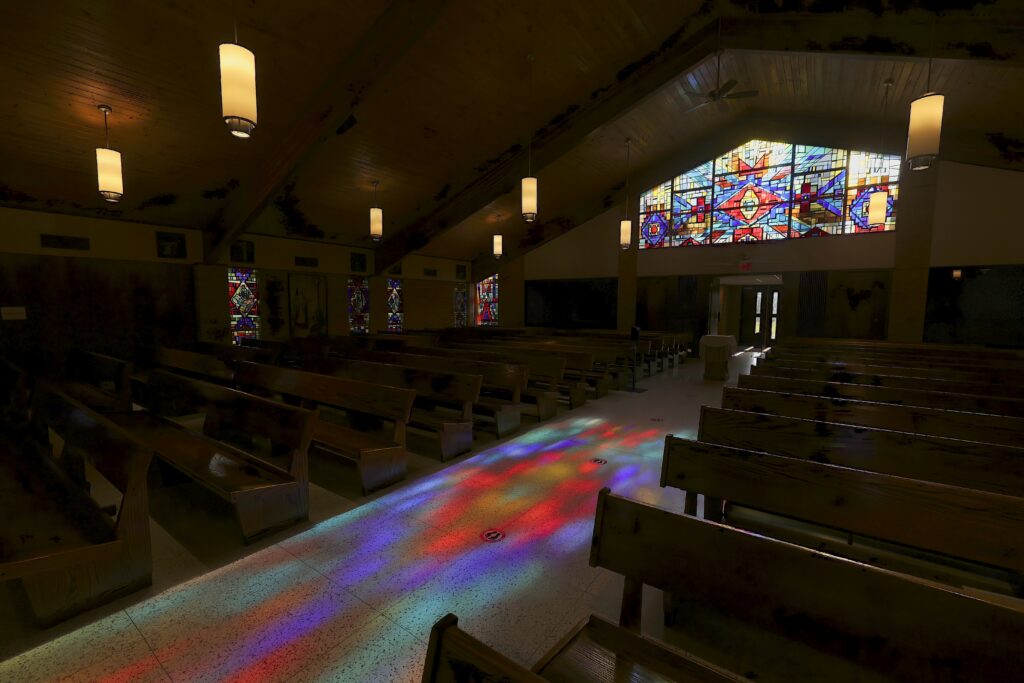
JOE DEJKA
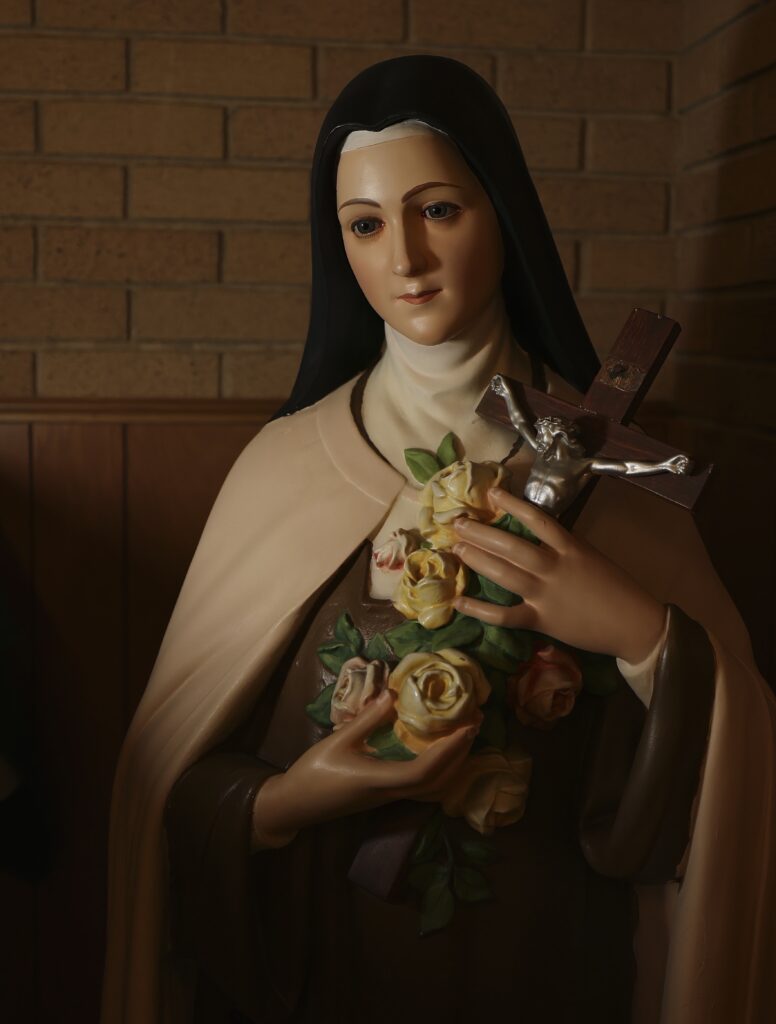
Statues like this one of St. Therese of Lisieux are displayed inside St. Augustine Church in Winnebago, Nebraska. Other statues depict Our Lady of Lourdes, St. Joseph, St. Jude Thaddeus and Infant Jesus of Prague. JOE DEJKA
READ MORE FROM THE CATHOLIC VOICE: